 CargoPlan OKcpok.com
Work out the load before you book the box.
The same 40 ft container holds 20 American pallets or 25 European ones — five more, from the same floor, because the pallet is a third narrower. That gap is what this site is for: pallet counts, tier heights, weight against payload, and the paperwork that decides whether it moves at all.
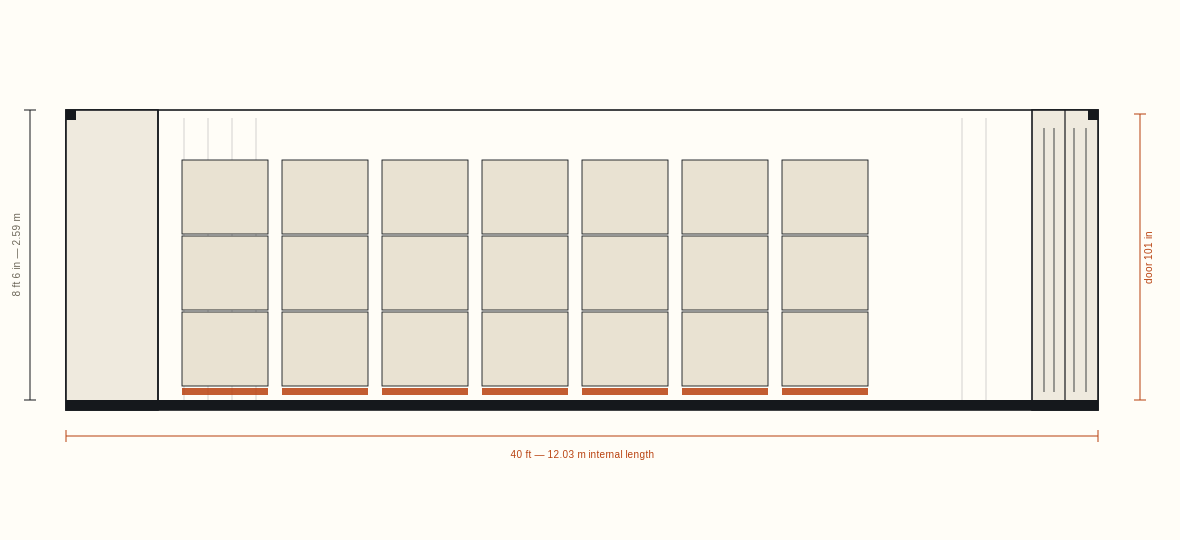
- Floor
- 474 × 92.5 in
- Door
- 92.5 × 101.3 in
- Payload
- 58,000 lb
The workbench
Three tools, no sign-upContainer load planner
How many pallets fit, how many tiers go up, and where the payload runs out.
Choose a box, choose a pallet, get a floor plan and a weight check. Catches the pallet that fits inside but won’t clear the door.
Density & freight class
The number a carrier asks for first, before it will quote you anything.
Pounds per cubic foot, the class band that usually follows, and the linear feet you’ll be billed for.
Packing materials
Film, tape, labels and corner boards, counted by the roll instead of by feel.
Built around how people actually wrap: layers, overlap, stretch. Includes the per-unit cost so you can compare vendors.
Container & pallet specs
The internal dimensions other calculators quietly round off.
Door openings, payloads, cube, and the pallet footprints used in the US, EU, UK, Asia and Australia.
Why the counts disagree
Read this before you quote a customerFloor plans aren’t rectangles
A 40 ft floor is 474 inches long and 92.5 wide. GMA pallets are 48 × 40, so two rows of nine fill 432 inches and leave a 42-inch strip that fits exactly one more pallet if you turn it. That’s 19. Start with the other orientation and you get 20. The difference is geometry, not opinion — and it’s why published counts range from 20 to 21.
Height decides the second tier
Two tiers of 48-inch pallets fit a high cube. Two tiers of 60-inch pallets don’t. Once the loaded pallet is over about 48 inches you’re usually looking at a single tier, and the useful question becomes whether a 40 ft is half empty.
The door is the real limit
A standard container has about 93.9 inches of internal height but only 89.5 inches of clear door. Anything built to 91 inches fits inside and never gets in. We flag it, because a load plan that ignores the door is a story about a forklift and a damaged frame.